What Happens on a Masaya Volcano Night Tour
From the moment a vehicle pulls up outside your hotel to the moment it drops you back, here is what a Masaya Volcano night tour actually consists of — and which parts the shorter fares leave out.
In this guide
- When does pickup happen, and why then?
- What is the drive like?
- What happens at the park gate?
- Why do the cars wait?
- What is the museum stop for?
- Is the El Comalito walk hard?
- When does the glow actually appear?
- How long do you get at the rim?
- Why is the rim window timed at all?
- What do you do while you wait?
- When do you get back?
- What changes if the tour is private?
- What surprises first-time visitors?
- The evening, in one table
When does pickup happen, and why then?
Late afternoon, almost universally. The evening session at the park opens in the late afternoon and the whole point of the exercise is to be inside the gate while there is still light, so that the daylight parts of the visit happen in daylight and the crater happens in the dark.
From Granada that means a pickup with an hour or so of margin. From Managua it means earlier, because the transfer runs around 45 minutes and late-afternoon traffic out of the capital is unpredictable. Your operator sets the exact time when you book, and it is worth being ready ten minutes before it.
What is the drive like?
Surfaced highway the whole way, through country that gets steadily more volcanic as you go. From Granada the road runs north-west; from Managua it runs south-east. Neither is demanding and neither needs a four-wheel drive.
The vehicle is usually a minibus or a van on a shared trip and a car or SUV on a private one. Several operators run air conditioning as standard, which matters more on the afternoon leg than on the way back.
What happens at the park gate?
Your guide handles admission. On most of these fares the park fee is already inside the price, so nothing changes hands; on three of them it is treated differently and their descriptions say which. Then the vehicle moves onto the caldera floor.
Some operators stop briefly just inside to look at the lava flow from an earlier eruption, which is a good use of five minutes and sets up everything you are about to see. The black rock beside the road is the volcano's own output.
Why do the cars wait?
Because vehicles are let up to the crater in batches, and there are only so many spaces on the rim. On a busy evening that means a wait somewhere on the park road, and it is the part of the itinerary nobody mentions when they sell you the tour.
A good operator fills that time with the museum, the fumaroles lookout or the walk out to El Comalito. A short tour that has none of those in it spends the wait sitting in a van in the dark. It is the single clearest difference between a $58 evening that feels full and an $80 one that does not.
What is the museum stop for?
The geological museum sits near the gate and takes ten to fifteen minutes. Inside are eruption maps, rock samples, a painted lava wall and a silver heat suit of the kind worn by researchers who have worked inside the crater.
Its real function is narrative. Standing at the rim later, the difference between looking at an orange glow and understanding what is producing it is entirely down to whether someone explained the vent, the plume and the collapse structure first. Masaya Volcano National Park describes what else is inside the gate.
Is the El Comalito walk hard?
No, but it is not paved. A gravel trail leads out from the road across the caldera floor to a small young cone that steams gently at the top. It takes fifteen to twenty minutes at an easy pace, the ground is loose rather than steep, and closed shoes make it comfortable.
Groups walk out in the last of the daylight and photograph the sun going down behind the crater rim from the top. It is consistently the part of the evening travellers describe most warmly, and it is the first thing the compact tours drop. Anyone who would find the ground difficult can wait at the vehicle without missing the volcano itself — Masaya Volcano accessibility covers where the ground changes.
When does the glow actually appear?
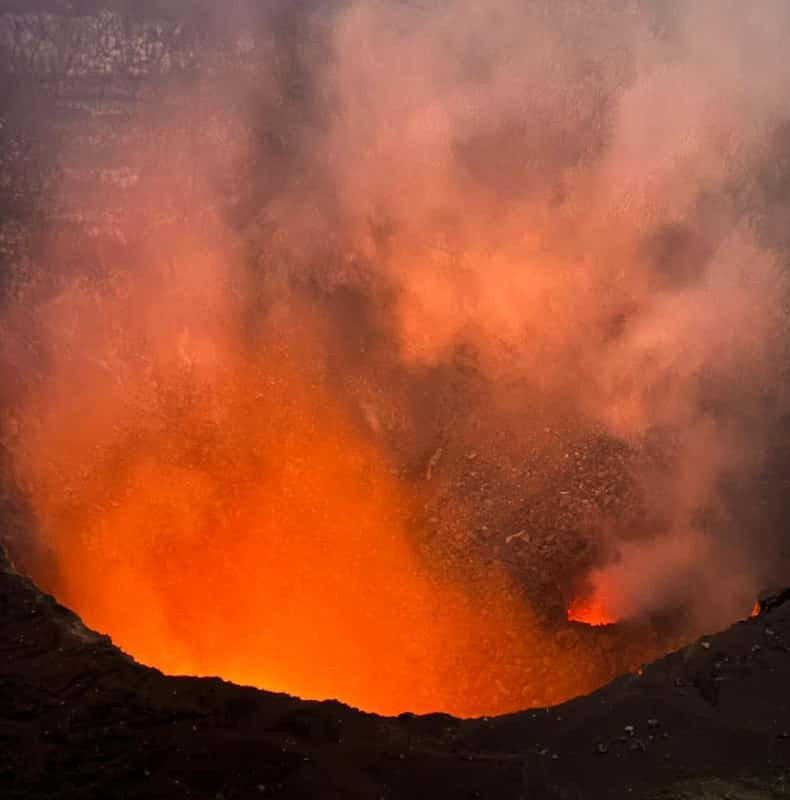
It does not appear; it becomes visible. The vent is incandescent all day and daylight simply drowns it. As the sky darkens the contrast climbs, and what looked like grey-white gas at five o'clock is orange by seven.
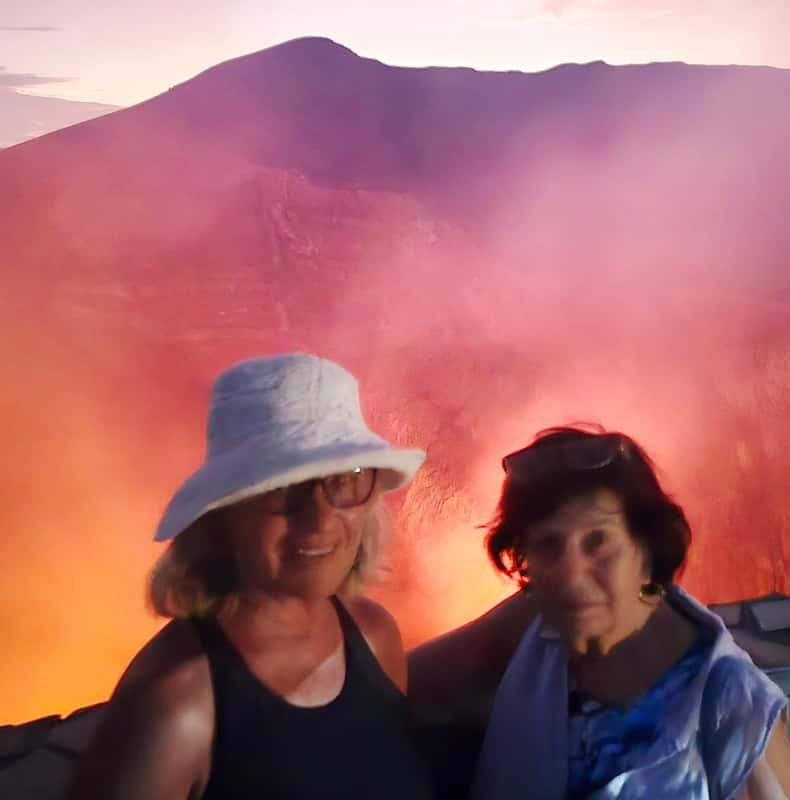
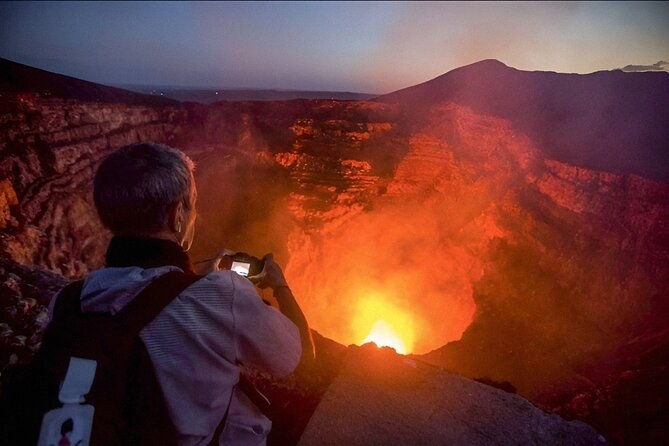
The best of it is blue hour — roughly twenty minutes after sunset when the sky still holds deep blue and the crater is already lit. That is also when the photographs work, which is why photographing Masaya Volcano at night pushes so hard on the timing.
How long do you get at the rim?
Published itineraries here range from fifteen minutes at the volcano to two hours, but the figure that matters is time at the railing, and that is short on every trip. Vehicles arrive in a batch, everyone gets out, and the group is moved along before long.
| Evening | Length | Published time at the volcano | Museum | El Comalito |
|---|---|---|---|---|
| Private night tour, Granada | 1.5 – 2 hrs | 2 hours | — | — |
| Small group, Granada | 2 hrs 30 | Not published | Yes | — |
| Night tour with museum, Granada | 2 – 3 hrs | 15 minutes | Yes | — |
| Private night tour, Managua | 2 – 3 hrs | 20 minutes | — | — |
| National park night tour, Granada | 4.5 hrs | Not published | Yes | Yes |
| Night tour from Managua | 3 – 5 hrs | 2 hours | — | Yes |
Why is the rim window timed at all?
Sulphur dioxide. The vent degasses continuously and the wind decides which side of the car park the plume crosses, so the park manages exposure by keeping visits brief and rotating vehicles through. Cars park facing outward, ready to leave.
It is the system working rather than failing, and it is the reason an ordinary visitor can stand on the lip of an active crater at all. Masaya Volcano safety explains how guides work with it.
What do you do while you wait?
- The museum — ten to fifteen minutes, and it makes the rim make sense.
- The Fumaroles Lookout — a short flat walk over ground that steams.
- El Comalito — the gravel trail and the sunset from the top.
- The Plaza de Oviedo — the cross on the crater lip, and the story behind it on the history of Masaya Volcano.
- The caldera view — from the high ground, with the last light across the lava fields.
An evening containing three or four of these survives a clouded crater. One containing none of them does not.
When do you get back?
A 90-minute to two-hour evening has you home for a late dinner. A two-and-a-half to three-hour one returns you mid-evening. The four-and-a-half-hour trip finishes later but covers everything, and the six-to-eight-hour combined days end the day entirely.
Return is to the point you were collected from on every trip compared here, which is worth remembering if you were thinking of walking out of the park to find a taxi. There are none at the gate after dark.
What changes if the tour is private?
The sequence stays the same — the park's rules do not bend for a fare. What changes is everything around it. A private vehicle waits while your group finishes at the museum rather than moving on a schedule, the guiding is aimed at whoever is in the car, and there is no fifteen-minute wait for the last two people to come back from the trail.
The other real difference is the return leg. On a shared evening the vehicle drops travellers in the order that suits the route, and if your hotel is last you are in the van for another twenty minutes. On a private one you go straight back.
What a private fare cannot buy is longer at the railing. That window belongs to the park.
What surprises first-time visitors?
- How short the crater stop is. People expect an hour and get a fraction of that, which is why an evening with other content matters.
- How ordinary the drive is. There is no expedition feeling; it is a good road and a car park.
- The smell. Sulphur dioxide is noticeable and slightly acrid, and it catches people who were not expecting to taste anything.
- How dark it gets. Tropical dusk is fast; the useful light goes in minutes rather than the hour a northern visitor expects.
- That the glow is reflected. You see orange thrown onto the far wall, not a river of lava at your feet.
None of these is a disappointment when you know it beforehand, and most of them are why the museum stop earns its place. Masaya Volcano facts covers the rest.
The evening, in one table
| Stage | Roughly | What happens |
|---|---|---|
| Pickup | Late afternoon | Collected from your hotel or an agreed point |
| Transfer | 25 – 45 minutes | Highway, then the park gate |
| Gate and lava flow | 10 minutes | Admission, and a look at old flow rock |
| Museum | 10 – 15 minutes | Eruption maps, samples, the heat suit |
| Trail or lookout | 20 – 40 minutes | El Comalito or the fumaroles, and the sunset |
| Queue for the rim | Variable | Vehicles admitted in batches |
| The crater | Short and timed | The Santiago viewpoint after dark |
| Return | 25 – 45 minutes | Back to your pickup point |
Questions this guide gets asked
How long is a Masaya Volcano night tour?
From 90 minutes to eight hours depending on what else is in it. The dedicated evenings run 90 minutes to four and a half hours; the combined day tours that add Granada or Laguna de Apoyo run six to eight.
What time does a Masaya Volcano night tour start?
Pickup is in the late afternoon so the group is inside the park before sunset. The exact time depends on your base city and is set by your operator when you book.
Do you get out of the vehicle at the crater?
Yes. The car park sits on the crater lip and the walk to the railing takes about a minute. The stop is short and timed, because of the gas.
Which tour has the fullest itinerary?
The four-and-a-half-hour evening from Granada. It covers the museum, the El Comalito sunset walk and the Santiago caldera after dark, with park entry, a snack and drinks in the fare. Nothing is collected at the gate.
Now you know the shape, pick the length that fits your evening on Masaya Volcano Tours. If the timing is your worry rather than the itinerary, the best time to see the glow has the seasonal picture.
Evenings with the fullest itinerary
The trips that fill the wait with the museum, the trail and the sunset rather than a van in the dark.