The Craters of Masaya Volcano
Short answer: the caldera holds two cones and five craters, but only one of them is doing anything. Santiago is the active crater, it is the one the road reaches, and it is the one that glows. The others are landforms you look at rather than places you go — except El Comalito, a small young cone you can walk to before sunset.
Most visitors arrive thinking of Masaya as a single crater. It is a caldera several kilometres across containing a whole family of vents, and knowing which is which turns the drive up into something more interesting than a transfer. Here is each of them, what it is, and whether you get anywhere near it.
Santiago — the active crater, and the reason for the road
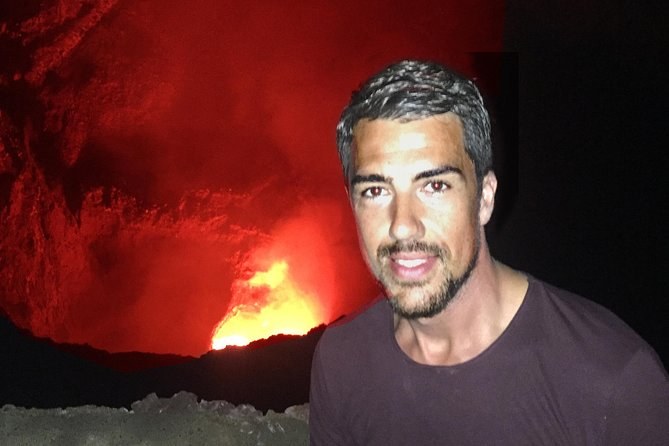
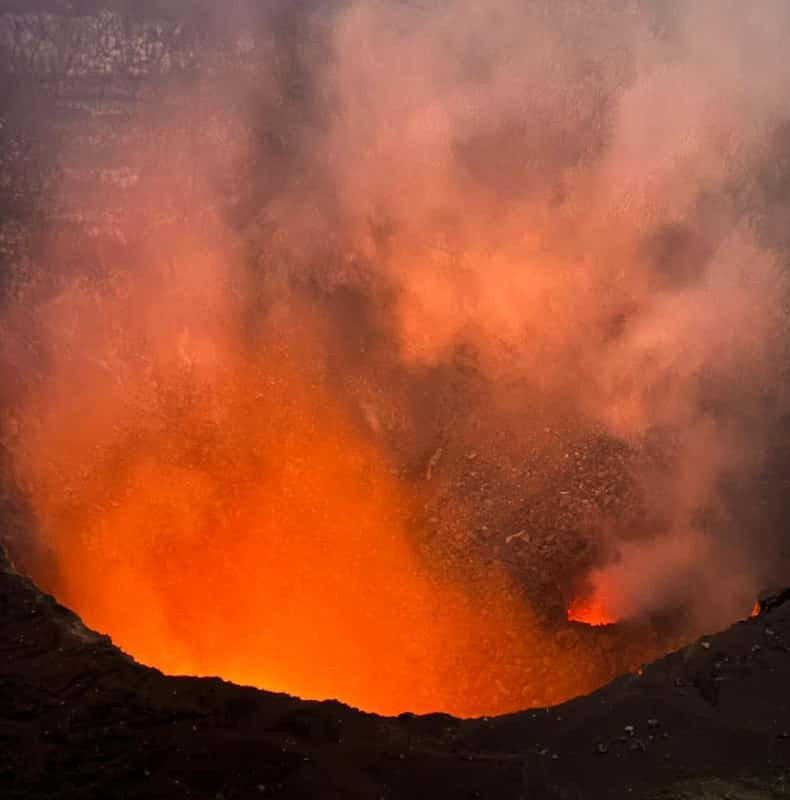
Santiago opened in the 1850s inside the older Nindirí cone, and it has been the business end of the volcano ever since. Its vent degasses continuously, and after dark the material at the bottom throws orange light onto the far wall. The paved road ends at a car park on its lip, so the walk from the vehicle to the railing takes about a minute.
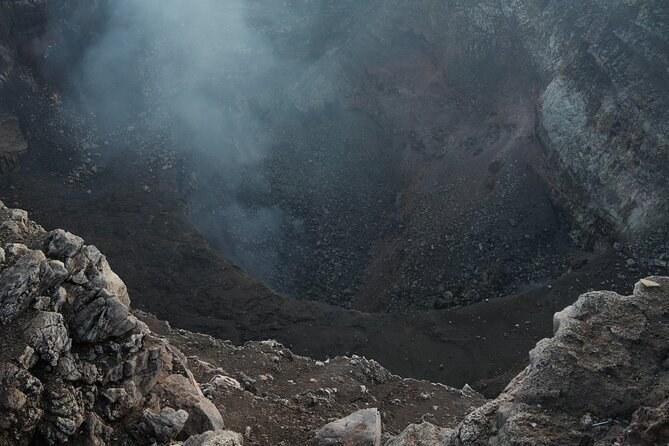
What you see from the terrace is a roughly circular pit several hundred metres across with terraced walls, where earlier crater floors collapsed inward. The vent itself is usually hidden behind its own plume. Masaya Volcano eruptions and activity covers what it has been doing lately.
Nindirí — the cone that Santiago sits inside
Nindirí is the larger structure and it takes its name from the town below. Santiago is a pit crater within it, which is why descriptions sometimes call the active vent by one name and sometimes by the other. From the crater terrace you are standing on Nindirí looking down into Santiago.
Masaya — the cone that gave everything its name
The second cone in the caldera, and the source of the historic lava flow whose black surface you drive across on the way in. It is quiet now. In daylight the contrast between old flow and scrub is obvious from the road, and it is worth asking your guide to point out where the flow front stopped.
How a caldera this size came to exist
Masaya is not a cone that grew and then blew its top. It is a caldera: a basin several kilometres across formed when the ground collapsed into the space left by erupted magma. The walls you can see from the high ground on the eastern side are the edge of that collapse, and everything inside — the cones, the craters, the lava fields — has been built or excavated since.
That geometry explains the drive. Once you are through the gate you are already inside the volcano, crossing its floor, and the climb at the end takes you up a cone that sits within it. Masaya Volcano facts has the measurements.
San Pedro and San Fernando — the older craters
Two further craters in the complex, both long inactive and both viewed rather than entered. They matter for what they show: a caldera does not have one throat, it has a series of them opening and closing over centuries. Santiago is simply the one that happens to be open now.
El Comalito — the one you can walk to
A small young cone on the caldera floor, reached on a gravel trail off the park road. Its name means the little griddle, and it steams like one. Groups walk out in the last of the daylight, photograph the sun dropping behind the crater rim, then drive up for the glow. It is the part of the evening travellers describe most warmly, and the short tours skip it.
💡 Did you know? A colony of green parakeets nests in the walls of the active vent, living inside a continuous sulphur dioxide plume that would drive most birds off. Guides point them out on the drive up, and nobody has a completely satisfying explanation for how they cope.
The craters compared
| Name | What it is | Active? | Can you reach it? |
|---|---|---|---|
| Santiago | Pit crater with the degassing vent | Yes | Yes — the road ends on its lip |
| Nindirí | The cone containing Santiago | Host structure | You stand on it |
| Masaya | The second cone; historic lava source | No | Seen from the caldera floor |
| San Pedro | Older crater in the complex | No | Viewed only |
| San Fernando | Older crater in the complex | No | Viewed only |
| El Comalito | Small young cone, steaming ground | Fumarolic | Yes — short gravel trail |
The lava fields between them
Between the cones the caldera floor is black rock, in places smooth and ropy, in places broken into rubble. It is the surface of old flows, the youngest of them from the historic eruption that came out of the Masaya cone. Scrub and cactus have colonised the older ground and left the newer flows bare, so the age of the surface is readable from the road as a change in vegetation.
Guides use this to explain what a basaltic volcano does: it leaks rather than explodes, and what it leaks spreads out. Masaya Volcano eruptions and activity covers the record.
The fumaroles, and where to see them up close
Beyond the named craters the caldera floor vents gas through open ground, and a signposted lookout puts you above it. It is a short flat walk from the road and it works in daylight, which makes it a natural first stop on an evening that starts early. Steam rising straight out of bare rock is a different sight from a crater plume and worth the ten minutes.
Which tours reach which craters
Every departure reaches Santiago — that is the point of the exercise. What separates them is whether they also give you El Comalito, the fumaroles lookout and the museum, and that comes down to how long the evening runs. Anything under two hours is the crater and the drive. Masaya Volcano National Park maps what an evening ticket lets you reach, and planning a visit to Masaya Volcano sets out what each fare covers at the gate. If access matters to your group, Masaya Volcano accessibility notes which parts of the caldera are level ground.
- Santiago only: the 90-minute to two-hour departures.
- Santiago plus the museum: most two-to-three-hour evenings.
- Everything, including El Comalito at sunset: the four-hour-plus trips.
Questions people ask about this
Which crater at Masaya Volcano is the active one?
Santiago. It is a pit crater inside the older Nindiri cone, it degasses continuously, and it is the one the park road delivers you to. Everything else in the caldera is quiet.
Can you walk down into the crater at Masaya Volcano?
No. Visitors stay on the paved terrace behind the barrier at the rim, and the visit is timed because of the gas. The only walking on a normal evening is the gravel trail out to El Comalito before sunset.
What is El Comalito?
A small young cone on the caldera floor with steaming ground, reached by a short gravel trail. It is where groups wait out the sunset. The longer evenings include it; the compact ones do not.
Which tour gives the most time inside the park?
The private evening from Granada publishes two hours at the volcano, the longest here. For the widest coverage of the park rather than the longest rim stop, the four-and-a-half-hour evening adds the museum and El Comalito.
Want the whole caldera rather than one stop? Compare evening lengths on Masaya Volcano Tours, or read Masaya Volcano facts for the numbers behind each cone.
Tours that reach the most of the park
The evenings with the longest time inside the gate, where the craters are.